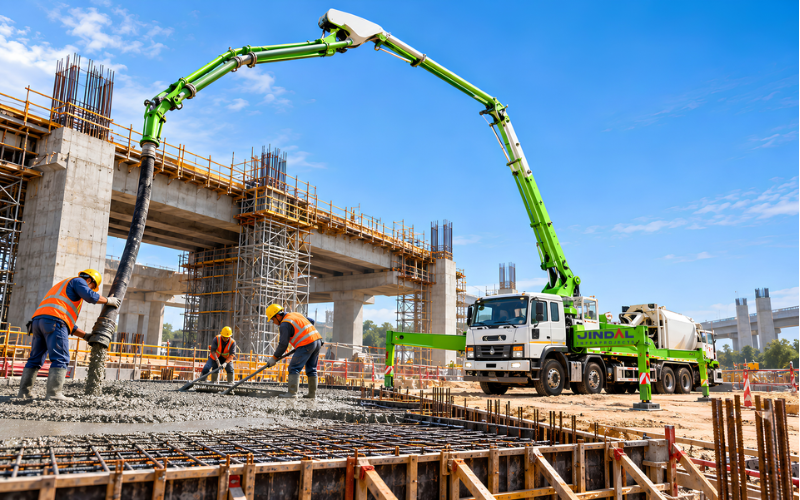
Concrete placement is a critical stage of construction, particularly on projects involving high-rise structures, bridges, infrastructure facilities, industrial buildings, and large concrete elements. As project size and construction height increase, moving concrete manually or using basic conveying methods can become increasingly challenging.
A concrete boom pump provides a controlled method of transporting and placing concrete through a pipeline connected to a hydraulically operated boom. For contractors handling large or complex construction projects, concrete boom pump rental can provide access to specialized concrete placement equipment without requiring the purchase of a dedicated machine.
The right boom pump needs to be selected according to project height, horizontal reach, concrete volume, site access, placement location, concrete specifications, and overall construction methodology.
What Is a Concrete Boom Pump?
A concrete boom pump is a concrete placement machine that uses a pumping system and articulated boom to deliver concrete to a designated location.
The machine generally consists of:
- Concrete receiving hopper
- Pumping mechanism
- Delivery pipeline
- Hydraulic system
- Articulated boom
- Control system
- Truck-mounted or suitable carrier configuration
The boom can be positioned to direct the delivery pipeline toward the required concrete placement area.
This allows concrete to be transported from the pump location to areas that may be difficult to access using conventional methods.
How Does a Concrete Boom Pump Work?
The concrete pumping process involves several stages.
1. Concrete Delivery to the Hopper
Ready-mix concrete is delivered to the pump and discharged into the receiving hopper.
The concrete must have suitable properties for the pumping system and project requirements.
2. Pumping
The pumping mechanism pushes the concrete through the delivery line.
The concrete travels through the pipeline toward the boom.
3. Boom Positioning
The operator positions the articulated boom according to the required placement location.
The boom can be adjusted to reach different areas within its operating envelope.
4. Concrete Placement
Concrete exits the delivery line at the required location.
The construction team then performs the necessary placing, vibration, levelling, and finishing operations according to the structural and project requirements.
5. Cleaning and Maintenance
After pumping operations, the equipment and delivery system need to be cleaned according to the manufacturer’s and project’s procedures.
Proper cleaning is important for maintaining the pumping system and reducing the risk of hardened concrete remaining in the pipeline.
Why Use a Concrete Boom Pump?
Concrete boom pumps offer several practical advantages for large construction projects.
Improved Reach
A boom pump can deliver concrete to locations that may be difficult to access using conventional concrete-handling methods.
Faster Concrete Placement
For suitable projects, pumping can support continuous concrete placement and reduce dependence on manual material movement.
Reduced Manual Handling
Concrete can be delivered through a pipeline directly to the placement area, reducing the need for extensive manual transportation.
Suitable for Large Projects
Boom pumps can be considered for projects requiring substantial quantities of concrete or placement at elevated or difficult-to-access locations.
Better Site Organization
Centralizing concrete delivery through a pumping system can help organize the concrete placement operation when properly planned.
Applications of Concrete Boom Pump Rental
Concrete boom pumps can be used in a wide range of construction applications.
High-Rise Construction
High-rise projects require concrete to be delivered to elevated levels.
A boom pump can support concrete placement where the machine’s reach and configuration are suitable for the project.
Residential and Commercial Buildings
Large residential complexes, commercial buildings, and mixed-use developments can require efficient concrete placement across multiple structural areas.
Bridge Construction
Bridge projects may involve foundations, piers, decks, approaches, and other concrete structures.
A boom pump can be used where its reach and site configuration meet the project’s requirements.
Metro and Infrastructure Projects
Metro construction can involve extensive concrete works across stations, viaducts, foundations, and other structures.
Concrete pumping equipment can support these operations when the project layout allows suitable positioning.
Industrial Projects
Factories, warehouses, power facilities, and other industrial structures can involve large concrete pours.
Boom pump rental can provide project-specific equipment for these construction stages.
Concrete Boom Pump vs Conventional Concrete Placement
Different construction projects use different methods for placing concrete.
| Factor | Concrete Boom Pump | Conventional Placement Methods |
|---|---|---|
| Concrete delivery | Through pipeline | May involve cranes, buckets, manual handling or other systems |
| Reach | Boom provides extended placement capability | Depends on method used |
| Large pours | Can support continuous pumping | May require more handling coordination |
| Elevated placement | Suitable configurations can reach elevated locations | May require additional lifting equipment |
| Site flexibility | Depends on boom and truck positioning | Depends on selected placement method |
| Labour requirements | Can reduce some manual material movement | May require additional handling |
The appropriate concrete placement method depends on the project design, concrete quantity, access, available equipment, and construction schedule.
Key Factors to Consider When Renting a Concrete Boom Pump
Selecting a boom pump based only on its general size is not sufficient.
1. Required Vertical Reach
Determine the highest point where concrete needs to be placed.
The pump should have a suitable boom configuration and operating range for the required height.
2. Required Horizontal Reach
The placement point may be located some distance from the equipment position.
Horizontal reach should therefore be considered alongside vertical reach.
3. Concrete Volume
Estimate the total concrete volume and expected placement rate.
This information helps determine whether the selected pumping equipment is appropriate for the planned pour.
4. Concrete Mix
Not every concrete mix behaves identically during pumping.
Factors such as aggregate size, workability, admixtures, cement content, and mix design can affect pumping behaviour.
The concrete supplier, contractor, and pump operator should coordinate to ensure that the concrete is appropriate for the pumping system.
5. Site Access
The pump needs to reach and position itself near the concrete placement area.
Consider:
- Road access
- Site entrance
- Turning space
- Ground conditions
- Overhead obstructions
- Nearby buildings
- Power lines
- Traffic movement
6. Boom Positioning
The available space must allow the boom to unfold and operate safely within its required working envelope.
7. Project Duration
Rental requirements should account for:
- Equipment mobilization
- Setup
- Concrete pours
- Standby requirements
- Demobilization
Concrete Boom Pump Rental for High-Rise Construction
High-rise construction presents specific concrete placement challenges.
Concrete may need to be delivered to multiple levels while maintaining an organized and continuous pouring operation.
Before using a boom pump, the construction team should consider:
- Building height
- Pump location
- Boom reach
- Pipeline arrangement
- Concrete supply
- Pour sequence
- Site access
- Traffic and material movement
- Communication between pump operator and placing crew
The equipment configuration should be selected based on the actual construction layout.
Concrete Boom Pump Rental for Bridge Projects
Bridge construction can involve large concrete elements and challenging site conditions.
A boom pump may be considered for:
- Foundations
- Piers
- Abutments
- Deck-related concrete work
- Approach structures
- Other suitable concrete elements
The required equipment depends on the location of the pour, access to the site, concrete volume, and required reach.
Concrete Boom Pump Rental for Metro Projects
Metro projects often involve repetitive concrete work across constrained urban locations.
Concrete placement may be required for:
- Viaduct structures
- Stations
- Foundations
- Piers
- Structural components
Equipment planning needs to consider movement between work zones, road access, traffic management, and the available operating area.
Importance of Concrete Mix for Pumping
Concrete mix design can have a significant impact on pumping performance.
The concrete needs to be suitable for movement through the pumping system and pipeline.
Important considerations may include:
- Aggregate size
- Workability
- Water-cement ratio
- Admixtures
- Cementitious material
- Concrete temperature
- Pumping distance
The required concrete mix should be established by the project’s concrete and structural requirements rather than changing the mix simply to accommodate the equipment.
Concrete Supply and Pump Coordination
A boom pump works most effectively when concrete supply is coordinated with the pumping operation.
If concrete delivery is inconsistent, the pumping operation may experience interruptions.
Project teams should coordinate:
- Ready-mix truck arrivals
- Pump location
- Concrete discharge
- Pour sequence
- Crew availability
- Pump operator communication
- Backup arrangements where necessary
Good coordination can help maintain a consistent concrete placement process.
Concrete Boom Pump Mobilization
Before equipment reaches the site, the project team should plan the mobilization process.
Site Entry
Confirm that the boom pump can access the site.
Positioning
Identify the most appropriate pump location based on reach and site conditions.
Ground Conditions
The equipment must be positioned on a suitable surface according to the manufacturer’s operating requirements.
Boom Clearance
Check for overhead and surrounding obstructions.
Concrete Truck Access
Ready-mix trucks must be able to approach and discharge into the pump hopper.
Setup
The pump should be set up and prepared according to applicable operating procedures before concrete placement begins.
Cleaning and Maintenance of a Concrete Boom Pump
Concrete pumping equipment requires appropriate cleaning and maintenance.
After a concrete pour, the pipeline and pumping system need to be cleaned according to the equipment manufacturer’s procedures.
Regular maintenance can include inspection of:
- Pumping components
- Delivery pipeline
- Hydraulic systems
- Boom components
- Hoppers
- Valves
- Wear components
- Control systems
The exact maintenance schedule depends on the equipment and operating conditions.
Concrete Boom Pump Rental vs Purchase
For contractors, renting and purchasing have different financial and operational implications.
| Factor | Boom Pump Rental | Boom Pump Purchase |
|---|---|---|
| Initial investment | Lower than outright purchase | Significant |
| Project-specific use | Suitable | Depends on fleet utilization |
| Maintenance | Depends on rental agreement | Owner responsibility |
| Storage | Rental provider responsibility may apply | Owner responsibility |
| Equipment flexibility | Can select equipment according to project | Limited to owned fleet |
| Long-term ownership | No | Yes |
Contractors should evaluate expected utilization, project duration, equipment availability, maintenance requirements, and overall operating costs before choosing between rental and purchase.
How to Choose a Concrete Boom Pump Rental Company
Selecting the rental provider is as important as selecting the equipment.
Equipment Availability
Confirm the required equipment is available for the planned concrete-pouring schedule.
Equipment Condition
The pump should be appropriately maintained and prepared for the intended work.
Technical Support
Clarify how equipment-related issues will be handled during the rental period.
Operator Arrangements
Confirm whether an experienced operator is included in the rental arrangement.
Mobilization Support
Discuss transportation, positioning, setup, and demobilization responsibilities.
Rental Terms
Clarify:
- Rental duration
- Working hours
- Mobilization charges
- Demobilization charges
- Operator charges
- Fuel
- Maintenance
- Breakdown support
- Standby charges
- Cleaning responsibilities
Concrete Boom Pump Rental From Jindal Projects
Jindal Projects provides construction equipment rental solutions for infrastructure and industrial projects, including concrete boom pump rental.
Its equipment rental services are positioned for construction and infrastructure applications where specialized equipment is required for project-specific operations.
For contractors considering a concrete boom pump, the equipment should be selected according to the required vertical and horizontal reach, concrete volume, concrete mix, site access, pump positioning, project duration, and placement requirements.
The exact machine configuration and rental arrangement should be confirmed based on the project’s requirements.
Conclusion
Concrete boom pump rental can provide an efficient concrete placement solution for large construction and infrastructure projects where concrete needs to be delivered to elevated or difficult-to-access locations.
The right boom pump should be selected based on the required vertical and horizontal reach, concrete volume, mix characteristics, site access, pump positioning, project schedule, and overall placement methodology.
Careful coordination between the construction team, ready-mix supplier, pump operator, and rental provider can help create a more organized concrete placement process.
