Large infrastructure and construction projects often involve lifting heavy structural components, machinery, steel sections, precast elements, and other materials at locations where conventional lifting equipment may not be suitable.
For such projects, crawler crane rental can provide access to heavy lifting equipment without requiring the project owner or contractor to purchase and maintain a dedicated crane fleet.
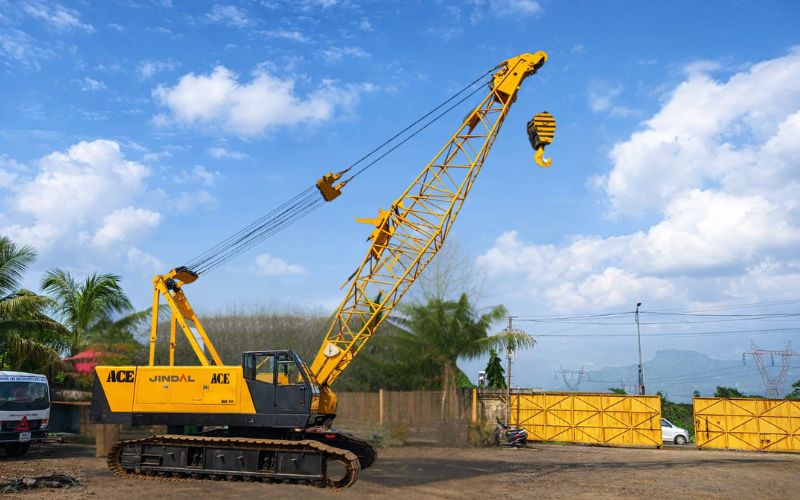
Crawler cranes are designed for heavy lifting and are mounted on crawler tracks rather than conventional tyres. Their tracked configuration allows them to operate on suitable project sites while carrying substantial loads. Depending on the crane model and site conditions, crawler cranes can be used for infrastructure construction, industrial projects, bridges, power plants, ports, and other heavy engineering applications.
For contractors evaluating crawler crane rental in India, selecting equipment according to the project’s lifting requirements, site conditions, working radius, load characteristics, and project duration is essential.
What Is a Crawler Crane?
A crawler crane is a heavy lifting machine mounted on continuous crawler tracks.
Unlike mobile cranes that operate primarily on tyres, crawler cranes use tracked undercarriages to move around a prepared worksite.
A crawler crane generally consists of:
- Crawler tracks
- Crane body
- Boom
- Counterweight
- Hoisting system
- Operator cabin
- Lifting accessories and rigging equipment
The exact configuration varies according to the crane model and manufacturer.
Crawler cranes are commonly considered for projects where heavy lifting capacity and stable operation on appropriately prepared ground are important.
Why Choose Crawler Crane Rental?
Purchasing a crawler crane represents a significant capital investment. It also involves storage, transportation, maintenance, inspections, trained operators, and other operational requirements.
For contractors with project-specific lifting requirements, renting equipment can provide a different approach.
Reduced Capital Investment
Rental allows contractors to access heavy lifting equipment without purchasing the machine outright.
This can be particularly relevant when a crawler crane is required for a specific project or limited duration.
Access to Project-Specific Equipment
Different projects have different lifting requirements.
Rental companies may provide access to equipment suited to the required lifting capacity, working conditions, and application.
Lower Equipment Ownership Responsibilities
When equipment is rented, responsibilities related to ownership, storage, and long-term fleet management can be different from those associated with purchasing equipment.
The exact responsibilities should be clearly defined in the rental agreement.
Suitable for Large Infrastructure Projects
Crawler cranes can be used in applications involving heavy structural components and industrial equipment, subject to crane capacity and site conditions.
Applications of Crawler Crane Rental
Crawler cranes can be used across a wide range of construction and infrastructure projects.
1. Bridge Construction
Bridge projects frequently involve lifting heavy components such as:
- Structural steel
- Precast elements
- Girders
- Reinforcement-related components
- Construction equipment
The appropriate crane depends on the load, lifting radius, site access, and installation sequence.
2. Metro Projects
Metro construction can involve lifting structural and mechanical components in environments with complex site restrictions.
Crawler crane rental may be considered where the project requires heavy lifting equipment and the site can accommodate tracked machinery.
3. Power Plant Construction
Power projects often involve the installation of large equipment and structural components.
Depending on the project phase, crawler cranes may be used for lifting heavy machinery and construction materials.
4. Industrial Projects
Industrial facilities can require heavy lifting during construction, expansion, equipment installation, and maintenance activities.
The crane configuration should be selected according to the specific load and lifting requirements.
5. Port and Infrastructure Projects
Ports and other major infrastructure developments can involve large structural components and equipment that require specialized lifting solutions.
Crawler cranes can be considered where their capacity and site configuration are suitable.
6. Steel and Cement Projects
Steel plants, cement facilities, and other heavy industrial projects may require lifting equipment for structural installation and machinery handling.
The required crane capacity depends on the individual lifting operation.
Key Factors to Consider Before Renting a Crawler Crane
Choosing a crawler crane should not be based on lifting capacity alone.
Several project-specific factors need to be evaluated.
1. Load Weight
The first consideration is the weight of the heaviest component that needs to be lifted.
However, knowing the load weight alone is not enough.
The crane’s capacity must also be evaluated at the required working radius and configuration.
2. Working Radius
The distance between the crane’s centre of rotation and the load position can significantly influence lifting capacity.
A crane that can lift a particular load at a short radius may not have the same capacity at a longer radius.
Therefore, the lift plan should include the actual working radius.
3. Lift Height
The required lifting height is another important factor.
The crane needs to have an appropriate boom configuration and operating range for the required lift.
4. Ground Conditions
Crawler cranes operate on tracks, but this does not mean that every surface is automatically suitable.
Ground bearing capacity, site preparation, gradients, underground structures, and other conditions should be assessed before mobilization.
5. Site Access
The site must have adequate access for crane transportation, assembly, operation, and eventual demobilization.
Infrastructure projects may have restricted access due to:
- Existing structures
- Roads
- Utility lines
- Adjacent buildings
- Excavations
- Traffic restrictions
These factors should be considered during project planning.
6. Crane Configuration
Crawler cranes can operate with different boom and counterweight configurations depending on the machine and application.
The configuration should be selected according to the required lift.
7. Lift Frequency
The number of lifts and expected operating hours can influence the rental decision.
A crane required continuously for several months may have different commercial and logistical considerations compared with equipment required for a small number of lifting operations.
8. Project Duration
Rental planning should take into account:
- Mobilization
- Assembly
- Operating period
- Maintenance requirements
- Demobilization
Accurate project scheduling can help reduce unnecessary equipment downtime.
Crawler Crane Rental vs Crane Purchase
For some contractors, the decision is between renting equipment and purchasing a crane.
| Factor | Crawler Crane Rental | Crane Purchase |
|---|---|---|
| Initial capital requirement | Generally lower than purchasing | Significant capital investment |
| Ownership | Equipment remains with rental provider | Contractor owns equipment |
| Project duration | Suitable for project-specific requirements | More suitable where long-term utilization is planned |
| Fleet flexibility | Equipment can be selected according to project | Limited to owned fleet |
| Storage | Rental arrangement may reduce long-term storage requirements | Owner is responsible |
| Maintenance | Responsibility depends on rental agreement | Owner generally manages maintenance |
| Asset utilization | Useful when equipment is needed periodically | Depends on utilization across projects |
There is no universal solution. Contractors should evaluate equipment utilization, project duration, financial considerations, logistics, and operational requirements before making a decision.
Importance of Lift Planning
A crawler crane should be selected as part of a complete lifting plan.
A lift plan may need to consider:
- Load weight
- Load dimensions
- Centre of gravity
- Pick-up location
- Set-down location
- Working radius
- Required lifting height
- Crane configuration
- Ground conditions
- Rigging arrangement
- Nearby structures
- Site access
- Weather and environmental conditions
The exact requirements depend on the lifting operation and applicable safety procedures.
What Equipment Is Used With a Crawler Crane?
A crawler crane does not operate independently of the lifting setup.
Depending on the project, additional equipment and accessories may include:
- Slings
- Shackles
- Spreader beams
- Lifting beams
- Rigging equipment
- Trailers
- Support equipment
- Site preparation equipment
All lifting accessories should be appropriate for the intended load and used according to applicable requirements.
Crawler Crane Mobilization
Mobilizing a crawler crane to a project site can involve several stages.
Transportation
Large crawler cranes may require specialized transportation arrangements because of their dimensions and weight.
Site Preparation
The project site may need suitable access routes and prepared operating areas.
Assembly
Depending on the crane, boom sections, counterweights, and other components may need to be assembled at the project site.
Inspection and Setup
Before lifting operations begin, the crane should be properly set up and inspected according to applicable procedures.
Demobilization
After the project or rental period is complete, the crane needs to be dismantled and transported from the site.
These logistics should be included in project planning rather than treated as an afterthought.
How to Select a Crawler Crane Rental Company
Selecting the equipment is only one part of the rental decision. The rental provider also needs to be evaluated.
Equipment Availability
Confirm that the required crane capacity and configuration are available for the planned project period.
Project Experience
Consider whether the rental provider has experience supporting infrastructure and heavy industrial applications similar to your project.
Technical Support
Equipment mobilization, setup, maintenance, and troubleshooting can require technical coordination.
Documentation
Appropriate equipment documentation and inspection records should be available as required for the project.
Operator Support
If operator services are included, clarify the operator’s experience and responsibilities as part of the rental arrangement.
Rental Terms
Clarify:
- Rental duration
- Mobilization charges
- Demobilization charges
- Operator arrangements
- Fuel responsibilities
- Maintenance responsibilities
- Breakdown support
- Overtime terms
- Insurance requirements
Clear commercial terms can help avoid misunderstandings during the project.
Crawler Crane Rental for Infrastructure Construction
Infrastructure projects often involve complex lifting environments.
Roads, bridges, metro systems, airports, ports, power facilities, and industrial projects may have different requirements for:
- Crane capacity
- Working radius
- Site access
- Ground conditions
- Lifting height
- Project duration
- Mobilization
This is why equipment selection should be based on the actual lifting plan rather than simply choosing the largest available crane.
Safety Considerations for Crawler Crane Operations
Heavy lifting requires proper planning and competent execution.
Before operating a crawler crane, project teams should consider:
- Approved lifting plans
- Crane inspection
- Ground assessment
- Load verification
- Proper rigging
- Exclusion zones
- Communication between lifting personnel
- Weather conditions
- Site hazards
- Operator competency
- Applicable safety procedures
The exact requirements depend on the project, equipment, jurisdiction, and applicable standards.
Why Equipment Selection Should Be Project-Specific
Two construction projects may require completely different crawler crane configurations even when the loads appear similar.
For example, one project may involve:
- A relatively short working radius
- Good site access
- Prepared ground
- Limited lifting height
Another may involve:
- Long working radius
- Restricted access
- Greater lifting height
- Complex site conditions
- Multiple heavy lifts
Therefore, crane selection should consider the entire lifting environment.
Crawler Crane Rental From Jindal Projects
Jindal Projects provides construction equipment rental solutions for infrastructure and industrial applications.
Its equipment rental portfolio includes crane rental and other specialized construction equipment intended for sectors such as infrastructure, metro projects, bridges, power plants, ports, roads, highways, and industrial projects.
For a project requiring crawler crane rental, the appropriate equipment should be selected according to the load, working radius, lifting height, ground conditions, site access, project duration, and lifting plan.
Project-specific equipment requirements should be discussed with the rental provider before mobilization.
Conclusion
Crawler crane rental can provide contractors and infrastructure developers with access to heavy lifting equipment for project-specific requirements without purchasing a dedicated crane fleet.
However, selecting the right crawler crane requires more than comparing lifting capacities. Load weight, working radius, lifting height, ground conditions, site access, crane configuration, project duration, mobilization, and the overall lifting plan all need to be considered.
For major infrastructure and industrial projects, working with an experienced equipment rental provider can help project teams identify equipment requirements and plan crane deployment according to the specific lifting operation.
